A Casino crash game that drifts like crazy
A crash game told through a drift car: the multiplier climbs while the car holds the slide, and the only decision is when to cash out.
- Role
- Design, art direction, engineering
- When
- Sep 2026 · playable prototype
- Where
- Mobile web · Three.js · Blender
Challenge
Make a crash game worth watching without handing the player any control — the car has to look like it is fighting for grip while the result is fixed before the round starts.
Approach
Treat the drive as the picture of the crash curve, not a driving game. Seed every round, prove the payout maths by simulation, and keep the car's drama on its own clock so it never gives the crash away.
Result
Playable in one day across 21 versions, with the payback flat at about 95% whether a player cashes out at 1.5x or at 25x.
What it is
The short version
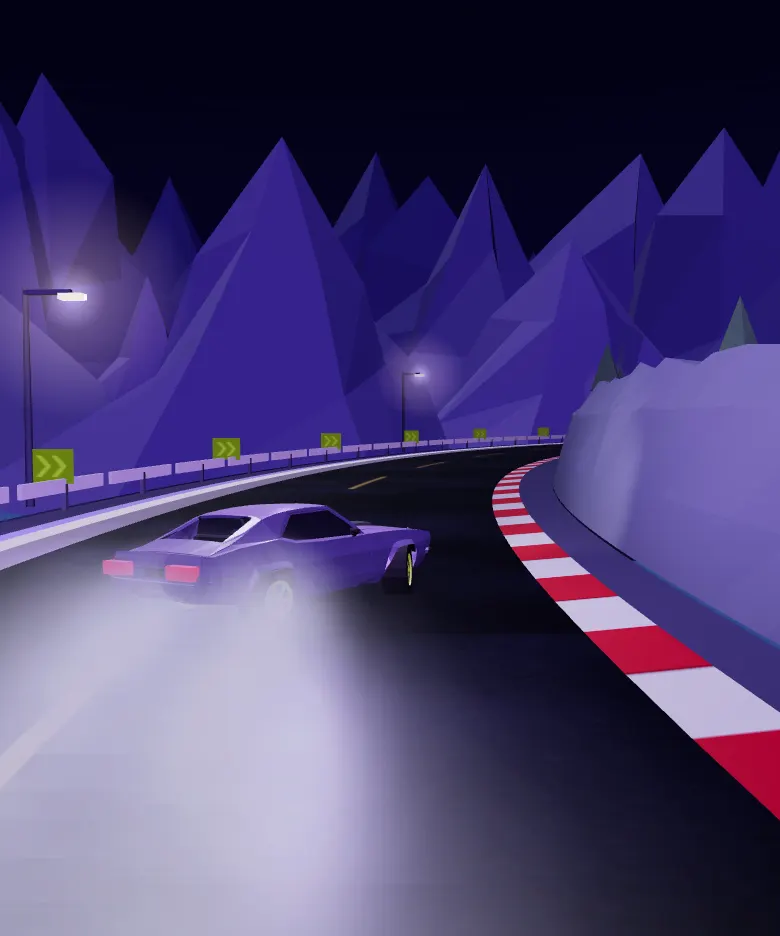
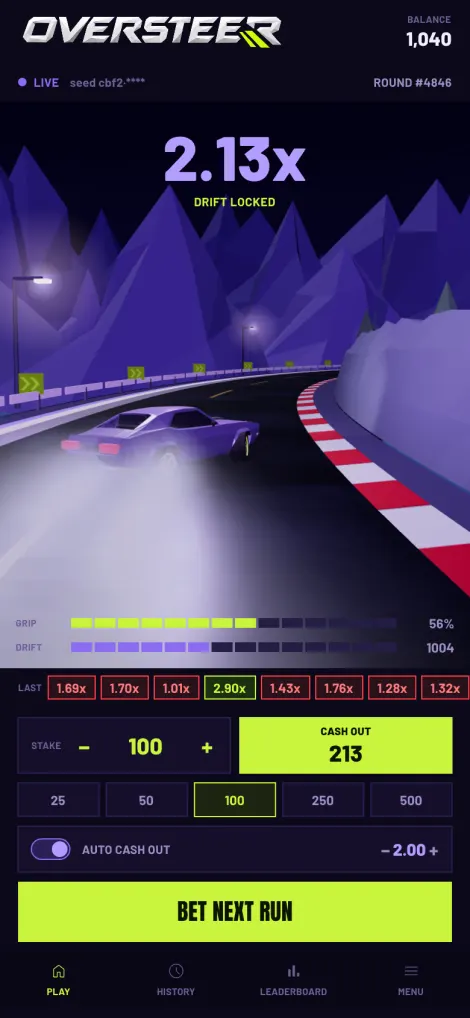
OVERSTEER is a crash game on one endless right-hand corner. The multiplier grows with time, a low-poly car holds a drift on the edge of a cliff, and cashing out before it goes over keeps the multiplier. Nobody steers.
Every round is seeded, and the seed is shown half before the round and in full after it, so any result can be checked. It is a prototype, so there are no players to quote — what it has is maths that has been verified rather than assumed.
Process
How it was built
- 01
Take the wheel away
The first versions let the player steer. Both were wrong: in a crash game any control is an edge. The final rule sits at the top of the project — enter, cash out, nothing else.
- 02
Prove the maths before the look
Seeded rounds and a 3% edge, simulated 400,000 times: median crash 1.89x, 47.5% of rounds reach 2x, and the payback holds flat across every cash-out target.
- 03
Keep the drama off the crash clock
The car steps out, grip drops, SNAPPING LOOSE — on its own random timer. Tie those moments to the crash point and the grip meter would tell players when to leave.
- 04
Rebuild the car the generator gave me
The generated model came with elliptical wheels welded into the body. Blender scripts cut them out and built round ones, then steering, spin and spoke aliasing were fixed one bug at a time.
Outcome
Where it landed
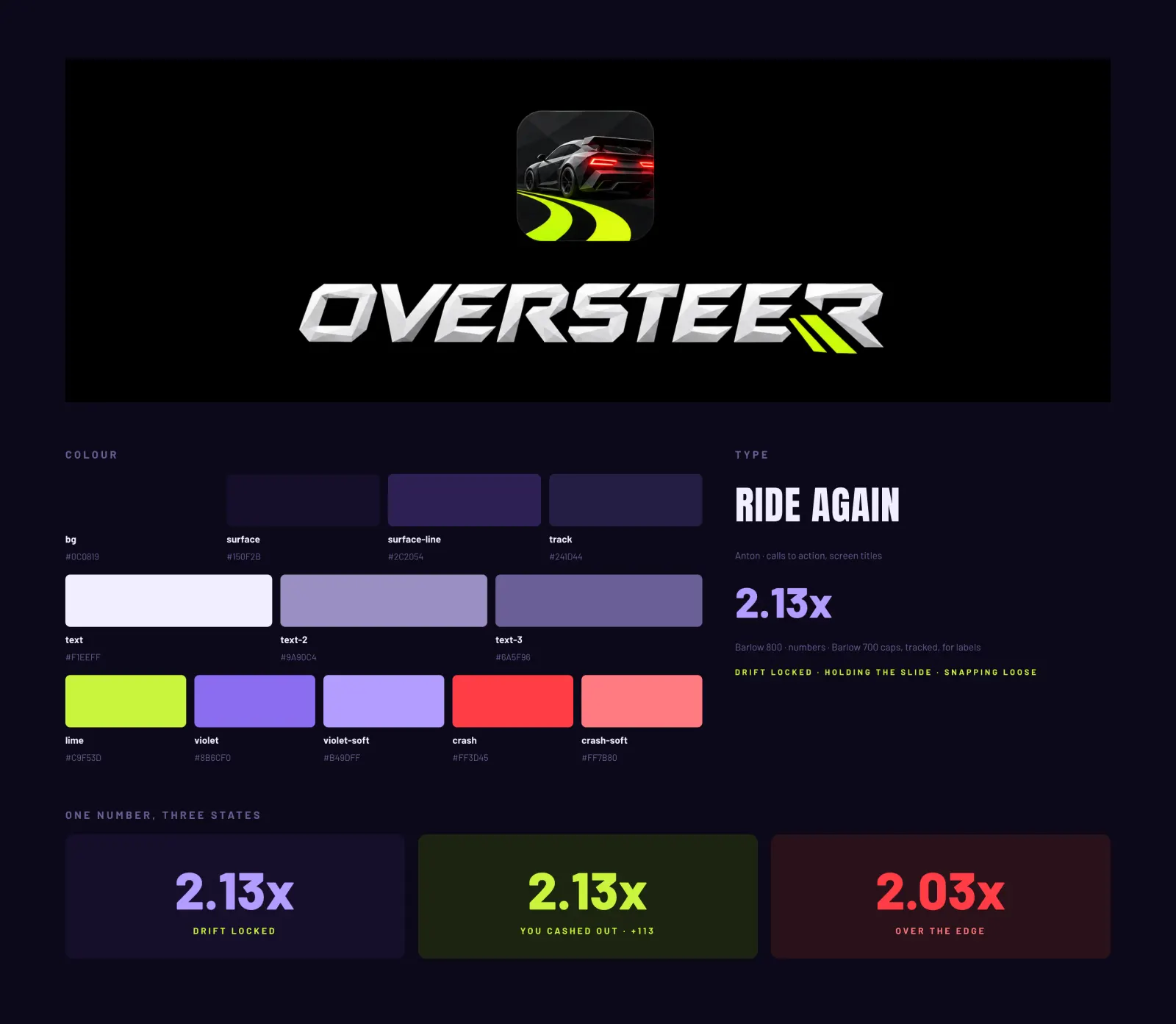
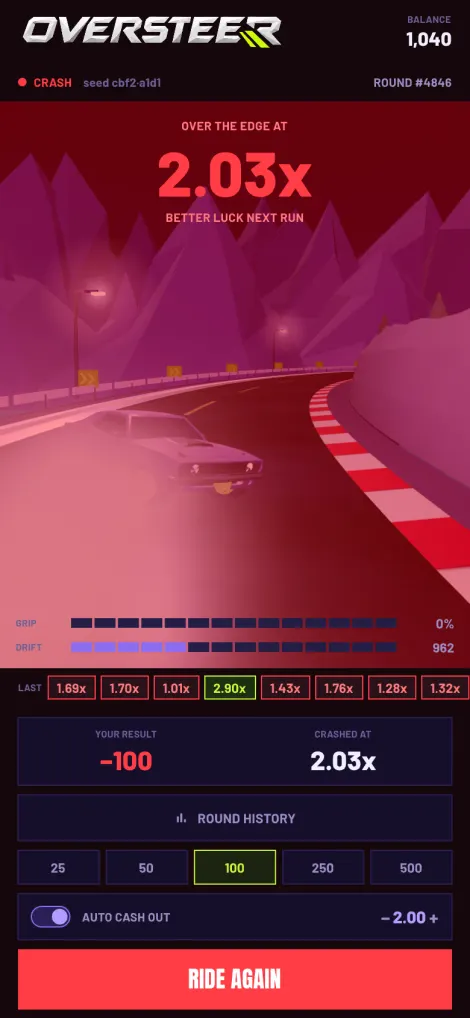
A playable prototype on mobile web, a four-screen round flow designed in Pencil around real gameplay frames, and a brand built on a chrome wordmark and a single racing line.
Lesson
What it cost me to learn
The most convincing part of a game of chance is the part the player cannot touch. Every time I gave them a steering input, the product got worse.